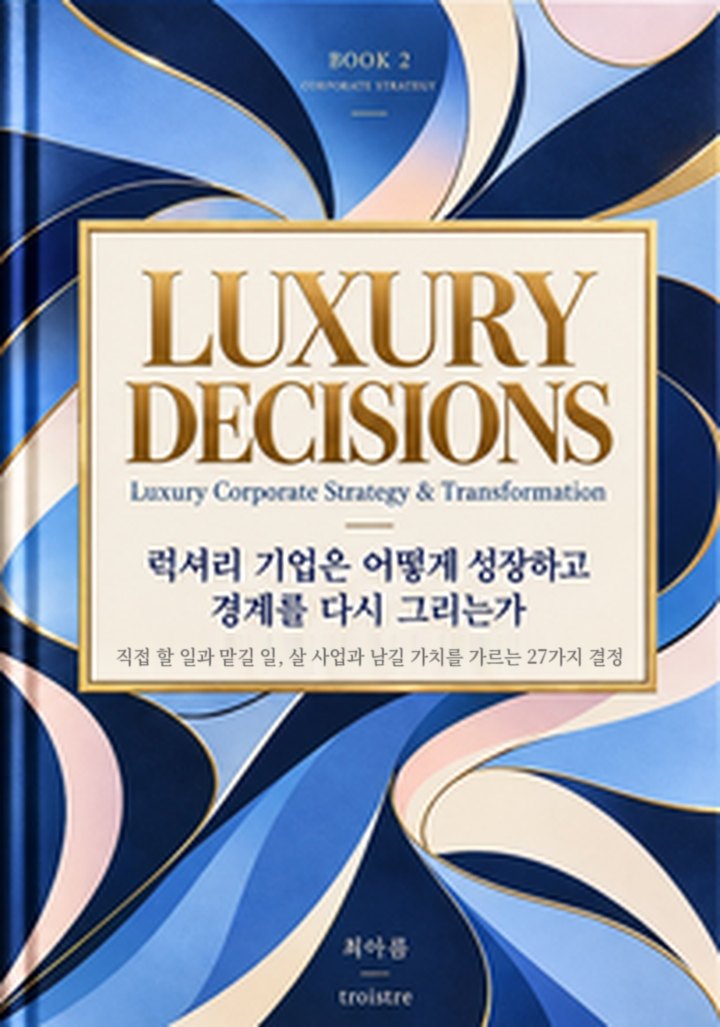
When luxury companies expand abroad or buy other firms, both moves go by the name of growth, yet what each one actually changes is not the same. From the perspective of corporate-level strategy, this book analyzes 27 decisions on internationalization, partnerships, mergers and acquisitions, integration, and restructuring, and reads their differences through four distinctions: location (where business is done), execution (who does the work), ownership (who holds the assets), and decision rights (who makes the key choices).
Cases include Thom Browne, whose Korean business and 17 stores were taken over from a franchise partner yet, according to its parent group’s filings, kept operating with that former partner’s external support; Chanel, which says the workshops it owns retain the ability to supply other houses; and Kering, which sold its beauty business to L’Oréal yet remained tied to the buyer through a 50-year license. The same framework is applied to Hermès’s Shang Xia, L’Oréal’s acquisition of Aesop, and LVMH’s acquisitions of Belmond and Bulgari.
Each chapter first examines the actual choice and, where familiar explanations fall short, brings in research on topics such as firm-specific advantages, global value chains, transaction costs and incomplete contracts, absorptive capacity and knowledge recombination, post-acquisition integration, and dynamic capabilities. Deal terms and accounting records in filings, proxy statements, court rulings, and audit reports are traced page by page, and figures from different documents are checked for what they actually count. The text keeps separate what companies disclosed, what research has established, and how the author applies those concepts to each case.